CanaryCultureCanary
Log in

The Framework

Human-AI Signals

AI is making a real difference. The tedious parts of the job shrink, people get through more of what they already do, and they can do things they were not able to do before. All of it means work moves faster.

But it also quietly takes things back.

For a person, that shows up as being less capable than you were, less able to judge whether the work is any good, and more alone in the day. For a team, AI becomes the colleague people go to first, so the team stops being where people learn and work drifts into silos. For an organisation, capability drains without anyone seeing it go, the work gets less original, and it surfaces later as turnover, rework and revenue that never appears.

What to keep an eye on

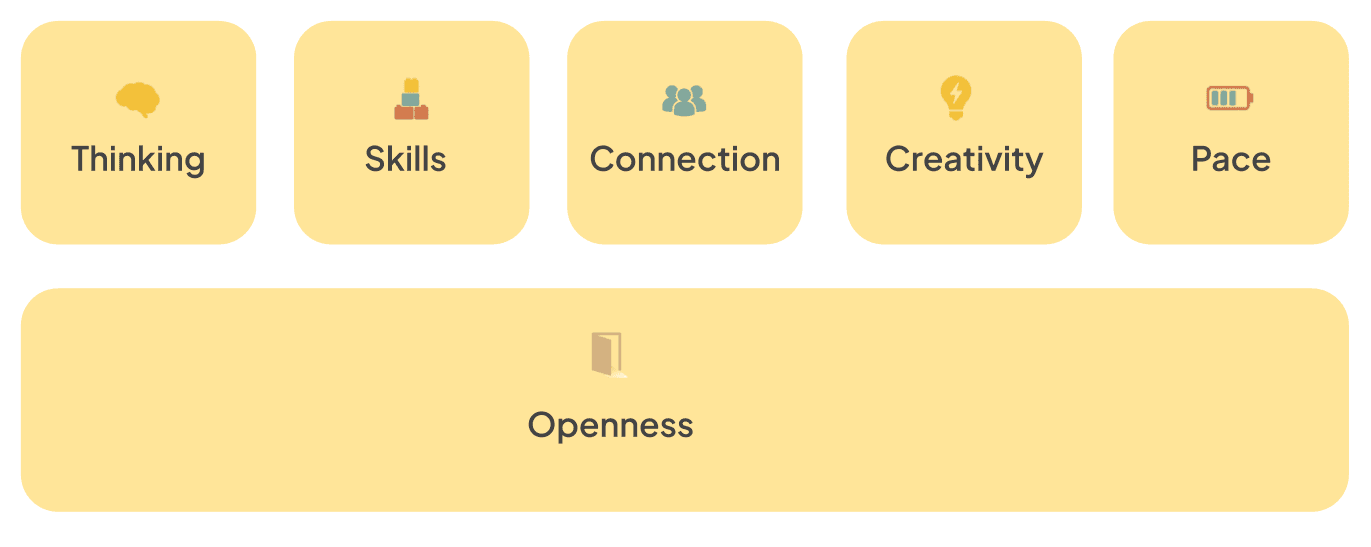
Five signals, with Openness underneath. Openness is not a sixth signal. It is what makes the other five readable, because if people cannot be honest the reading is noise.

The five signals — Thinking, Skills, Connection, Creativity and Pace — shown as five cards resting on a wider bar labelled Openness.

The signals in detail

Thinking

gain thinkinglose the critical part

AI can genuinely help you weigh things up and make a call, and it is often good at it. What goes missing is your own habit of questioning it. The answer arrives looking finished, so it goes through, and the more often it turns out to be right the less anyone bothers to look.

Healthy looks like

  • People change or reject AI output regularly, not now and then
  • Someone can explain why the work is right, not just that it is
Skills

gain outputlose capability

AI does the work, so you stop doing it. Not all of that is a loss, formatting, boilerplate and first-draft busywork were never the point. The risk is when the same habit spreads to judgment calls, and people hand those over too, by habit rather than by choice.

Healthy looks like

  • People know which of their skills are worth protecting, and let the rest go
  • People can still do the core of their job without AI when they need to

Connection

gain answerslose each other

It is faster to ask the machine than the person next to you. Do that for long enough and the team stops being how people learn things. Fewer questions in the open, fewer overheard answers, thinner relationships.

Healthy looks like

  • Questions still get asked in the open, not only to the machine
  • Someone new can learn from the team, not just from a chatbot

Creativity

gain consistencylose originality

Everything comes out competent and slightly the same. Ideas converge on whatever the tool suggested first, and the strange ones stop making it out of the first ten minutes.

Healthy looks like

  • Odd ideas still survive the first ten minutes
  • Work from different people still sounds different

Pace

gain capacitylose rest

People can do more, so more gets asked. The time saved does not come back as breathing room. It comes back as more work, and it quietly spreads into lunch breaks and evenings.

Healthy looks like

  • Time saved shows up as time, not as more work
  • Focus blocks survive the week

Openness

Underneath all five · start here

Can people be honest about how they are actually using AI, without it being treated as cheating? This is psychological safety pointed at one specific thing. Nothing is exchanged for it and AI does not hand it to you. What it does is decide whether anything else you measure is true.

Healthy looks like

  • People say which parts of the work AI did, without hedging it
  • Nobody has to guess how their colleagues actually work

Key principles

Make it safe

  • Anonymous by default.
  • Only aggregated results leave the team.
  • Start with openness and clarity about what is allowed.

Find your rhythm

  • Pick a cadence that fits how the team already works.
  • Make sure reflection has a cadence too, not just the pulse.
  • Use the meetings you already have.

Experiment

  • Trial a new practice or activity.
  • Let the pulse and reflection tell you whether it is working and worth keeping.

How it works

Where to start

Before the first pulse, get clarity on what is allowed and what is not. Some of that is organisational, rules that already exist about what can go into which tool. Some of it is the team's own view of what should and should not be handed over.

The point is not a policy document. It is visibility of what people actually think, and ideally an agreement they had a hand in.

This doubles as the first real lift in psychological safety, which is what a team needs most going through change this fast.

Coordinating it

A coach, the team lead, or someone in the team. Taking turns works fine. What matters is that somebody owns the rhythm, and that the check-ins stay anonymous.

The loops

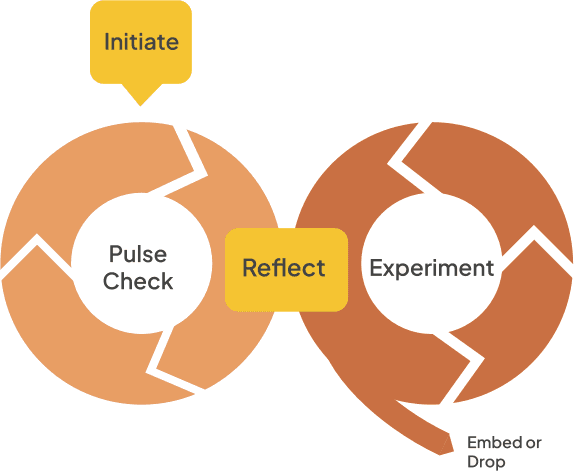
The Human-AI Signals framework. Initiate feeds into the Pulse Check cycle. Pulse Check and Experiment are two connected cycles, joined in the middle by Reflect. An experiment ends by being embedded or dropped.

Initiate

Before anything else, get the team on the same page. Get clear on any organisational policies or restrictions on AI use that already apply.

As a team, talk through the specific scenarios: what feels right to use AI for, what does not, and where you agree or do not. It might be worth putting that into a short team agreement.

Pulse Check

A short, anonymous check-in on how people are actually doing right now. It surfaces how the team is doing across the five signals that week, including the parts people are less likely to say out loud with their name on it.

Experiment

Try a change based on what reflection turned up, and give it real time to show up in future pulse checks and decide if it is worth embedding as an ongoing practice.

Reflection

Bring the pulse results to the team and look at them together. Say what is moving, in both directions.

Decide: keep what is working, change or drop what is not, and agree the next thing to try.

What it is not

  • Not a framework about using less AI, it is about how it gets used.
  • Not a framework for measuring performance. It says nothing about any individual, and should never be read as though it does.
  • Not an audit framework or one-off assessment.

What it is

  • A way to notice what AI is changing about how a team works, while the change is still small enough to do something about.
  • Visibility into what is changing before it becomes a problem, and a recurring habit, not a one-time check.
  • A way to make how AI gets used something the team decides together, rather than drifts into.